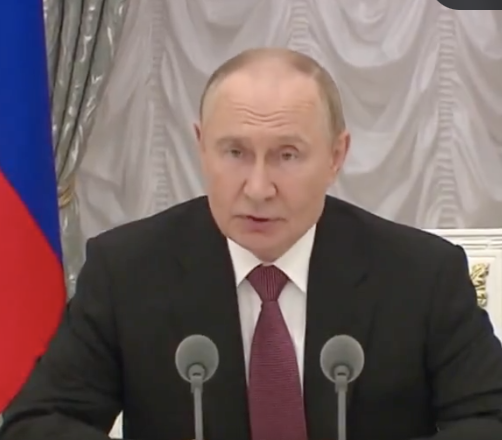
The video from Russia Today (RT) (below) shows Russian President Vladimir Putin briefing a group of Russian officials in a Kremlin hall after the Alaska summit on August 15, 2025. He calls the summit “timely and very useful,” noting it covered bilateral cooperation but focused mainly on resolving the Ukraine crisis on a “fair basis.”
Putin highlights discussions on the “genesis” and root causes of the conflict, stressing the need to eliminate these for a lasting settlement. He mentions that such high-level talks hadn’t occurred in a long time, allowing Russia to explain its position in detail.
While acknowledging the U.S. desire for an immediate ceasefire—which Russia also supports—he emphasizes resolving all issues through peaceful means. The conversation was “frank,” bringing parties closer to solutions, though no specific agreements are detailed. Putin offers to share more and take questions.
🚨⚡️BREAKING:
— RussiaNews 🇷🇺 (@mog_russEN) August 16, 2025
Kremlin: Putin holds a meeting on the results of the Alaska summit. pic.twitter.com/JtvwfLDuUo
Implications for the Peace Process
President Trump’s announcement on August 16, 2025, via Truth Social, that talks should move directly to a comprehensive peace agreement rather than a preliminary ceasefire represents a pivot from his earlier push for an immediate halt to fighting. This approach echoes Putin’s stance at the Alaska summit, where no ceasefire was achieved despite U.S. expectations. For the peace process, bypassing a ceasefire could hasten a final deal if parties align, but it carries risks: continued combat might erode Ukraine’s leverage, enabling Russia to apply military pressure during negotiations.
There is no way to describe today other than an absolute victory for Trump.
— Clandestine (@WarClandestine) August 15, 2025
Putin confirmed there would be no escalation if Trump was POTUS the last 4 years.
Today, Trump proved he is far superior than Biden and the Dems.
There is no denying it.
pic.twitter.com/duhHfjS6aY
Russian officials view the summit as a win for Moscow, potentially involving Ukrainian territorial concessions and curbs on its NATO path. The US is also touting a successful outcome. This reveals it is diplomacy that’s working.
Trump has warned of “very severe consequences” if Russia blocks progress, though he delayed tariffs on Russian oil importers post-summit. Overall, the shift boosts U.S.-Russia dialogue but may extend the conflict if Ukraine rejects terms, while straining transatlantic unity.
Where Zelenskyy Stands
Ukrainian President Volodymyr Zelenskyy expresses cautious support for dialogue but insists on a “just and lasting” peace, rejecting any “pause” that could enable future Russian aggression. He is set to meet Trump in Washington on August 18, 2025, to cover “all details” on ending the war, including a proposed trilateral format with the U.S., Russia, and Ukraine. Zelenskyy opposes territorial concessions, demanding full Russian withdrawal, release of prisoners and abducted children, and no Russian veto on Ukraine’s NATO or EU aspirations. He advocates maintaining sanctions and pressure on Russia if it evades honest talks, and supports negotiations only under a ceasefire. Zelenskyy coordinates closely with European leaders for unified positions, emphasizing U.S.-European security guarantees.
Where NATO Stands
NATO steadfastly supports Ukraine, insisting any peace must be “just,” uphold Ukraine’s sovereignty, territorial integrity, and right to pursue NATO membership without Russian interference. The alliance rejects Russian demands like vetoes on Ukraine’s NATO path or military restrictions. NATO has pledged over $500 million in new military aid packages in August 2025, including equipment and munitions via its Prioritised Ukraine Requirements List, funded by Allies like Germany, Denmark, Norway, Sweden, and the Netherlands. While welcoming U.S.-Russia engagement, NATO stresses Ukraine’s central role in talks and warns that forgoing a ceasefire risks prolonging the war; it commits to sustained sanctions and pressure on Russia until aggression ends.
NATO as a stumbling block
NATO could become a stumbling block in U.S.-Russia peace talks on Ukraine, as the alliance insists on preserving Ukraine’s territorial integrity, sovereignty, and right to NATO membership without concessions to Russian demands like land cessions or vetoes on expansion. Following the August 15, 2025, Alaska summit—where no ceasefire emerged—Trump emphasized needing NATO’s “sign off” for any deal, highlighting potential tensions if proposals involve recognizing Russian gains in Donbas for decades or lifting sanctions, which NATO views as rewarding aggression and undermining deterrence. Allies like the UK and Poland prioritize a ceasefire first and continue arming Ukraine with over $500 million in recent aid, potentially clashing with Trump’s direct peace approach and straining transatlantic unity.

However, Trump’s favorable comments on NATO’s role and productive talks with leaders suggest partial alignment, with Secretary General Mark Rutte open to strong security guarantees for Ukraine, though he rejects Putin’s core terms. While this indicates Rutte may be onboard for dialogue, deep differences could still position NATO as a veto rather than enabler.